
You've Lost Yourself? Here's How to Find Your Way Back
Jun 25, 2026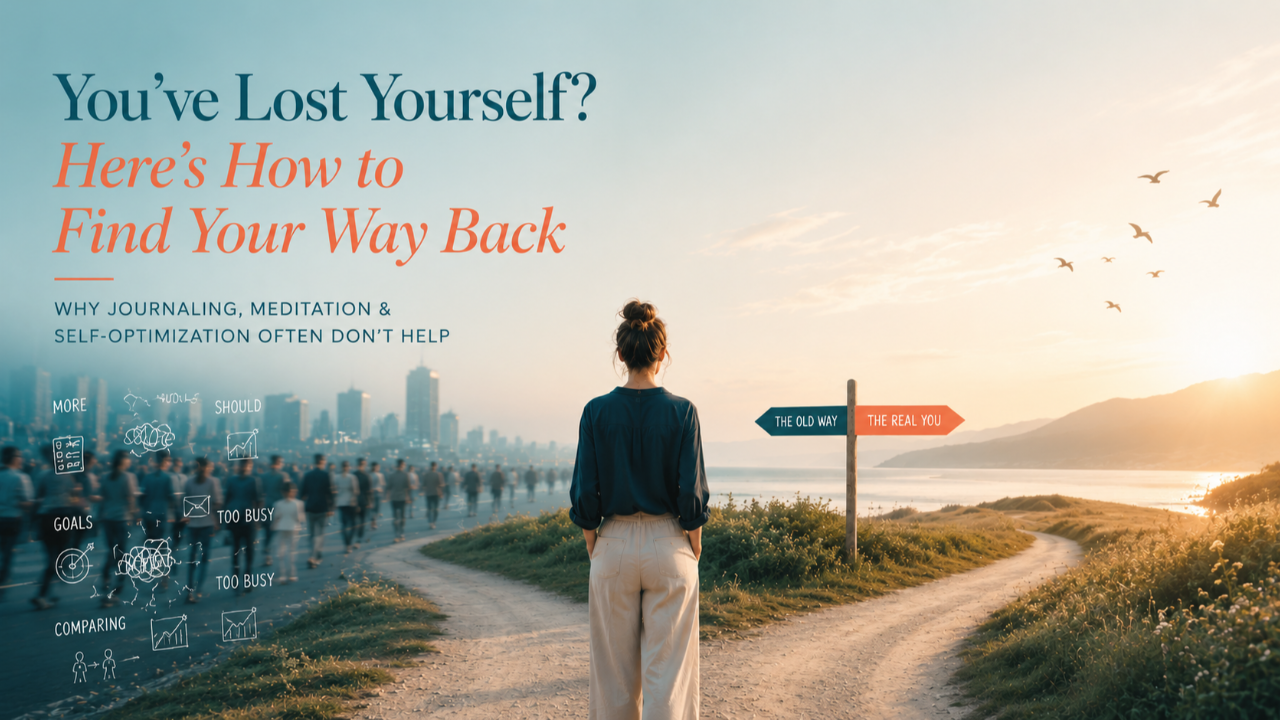
Table of Contents
- How do I know I've lost myself?
- Why do we lose ourselves?
- Finding yourself vs. reinventing yourself: the crucial difference
- Why journaling, meditation, and self-optimization often don't help
- How do I find my way back to myself? (3 concrete steps)
- What changes when you're back to yourself?
- When does it make sense to seek support?
- Frequently asked questions
How do I know I've lost myself?
There's this moment in the evening.
You come home, close the door behind you, and suddenly you're yourself again. Like taking off a mask. As if the person who'd been out in the world all day was someone else entirely.
But it was the same person. You.
That feeling — that disconnection between who you are on the outside and who you are on the inside — is the first sign that you've somehow lost yourself.
It's not a loud alarm signal. It's not a dramatic breakdown. It's subtle. It's gradual. And that's exactly why most people don't recognize it for what it is.
My coaching clients rarely say: "Shailia, I've lost myself."
They say:
"I'm working too much, and I don't know why anymore."
"I have no time left for the people who really matter to me."
"I do things, but they don't feel like me."
It's only when we pause together that it becomes clearer: at some point, they traded away what truly mattered to them — for a version of themselves that wasn't really theirs. Step by step. Decision by decision. Without noticing.
One of my coaching clients was building her own business. One evening, she seriously asked herself whether she needed to do handstands on Instagram — because another woman in her marketing group had gone viral doing exactly that.
In that moment, she stopped.
"That's not me," she thought.
"That's not how I want to do things."
That was her turning point. She'd felt something essential: the difference between true herself and the role she was supposed to play, according to someone else.
Common signs that you've lost yourself:
- You make decisions out of pressure, fear, or habit — not out of inner knowing or your own conviction
- You no longer know what you truly want, separate from what you think you should want
- You function well on the outside but feel empty or off on the inside
- You follow trends, advice, or other people's expectations without asking whether they actually fit you
- You remember a time when you felt "more like yourself"
Why do we lose ourselves?
The honest answer: nobody does it on purpose. It is so innocent.
It happens through a thousand small, unreflected decisions. Through expectations we follow without ever truly questioning them. Through stories in our heads that tell us who we need to be and what we need to do — to be safe, to be enough, simply to belong. Or because that's just what people do.
I've experienced this myself.
When I was first building my coaching practice, I paid a lot of money for business mentors who told me how to present myself. I was supposed to be seen at a yacht club, wear fancy clothes, and straighten my hair.
They advised me to show up in the world in a particular way, as a signal to others that I was successful.
And I did it for a while. Without thinking it through nearly enough. Decision by decision and step by step, I moved further and further away from myself.
The insidious thing about it: each individual decision seemed reasonable. Logical. Even necessary. It was only with distance that I recognized what had happened — I'd tried to become someone else, because I believed that "advancing" version of me would be more successful than I was.
Society, parents, partners, employers, the market — they all set the rules. We follow them without pausing. Without asking: Is this really me? Do I want this? Do I believe in this?
And at some point, you find yourself standing in a life that feels like a suit that doesn't fit.
The decisive moment isn't the moment you lose yourself. You barely notice that one. The decisive moment is when you start to sense that something is wrong, and you don't look away.
Related article:
Why You're Stuck in Life, and How to Get Unstuck
Finding yourself vs. reinventing yourself: the crucial difference
There's a growing movement right now, especially online. It calls itself Identity Work. The message: recreate yourself. Decide who you want to be. Grow into the image of an ideal future version of you.
I want to be someone who earns ten million a year. I want to be someone with a lean body. I want to be someone who is flourishing in a loving relationship.
Then you project yourself onto that image — and ask yourself with every decision: what would that person do?
It sounds powerful. And for certain goals, it can work. But finding yourself means the exact opposite. Not building or creating a new you. Not becoming a better version of yourself.
Instead: recognizing what was always already there.
You are not suboptimal. You are not incomplete. You don't need to become something you aren't yet. You only need to stop playing someone you're not — and return to what has been waiting beneath all those added layers all along.
That might sound too simple. Not spectacular enough. We live in a time when everyone wants to be extraordinary. When transformation is supposed to be big and visible.
But the path back to yourself is often quiet. Completely unremarkable. And that's exactly what makes it harder to walk than any kind of self-reinvention.
It requires the willingness to be entirely ordinary.
Related article:
Stopping the Mental Spiral When Your Mind Won't Stop Thinking
Why journaling, meditation, and self-optimization often don't help
When people realize they've lost themselves, they reach for strategies and tools.
They start working on themselves. Writing. Searching. They book courses, collect methods, sign up for retreats.
One of my coaching clients had completed over thirty training programs in twenty years: somatic work, breathwork, meditation, and so many various forms of therapy.
She was trying to fix herself through more knowledge and certain techniques. And yet the answer she was looking for had been inside her the whole time.
The problem isn't that these methods are bad. The problem is why we use them: as tools meant to fix, from the outside, what we experience as an inner problem.
Journaling can help organize your thoughts. But an orderly mind is not the same as stillness within.
Meditation can help calm the mind. But a quieter version of the same lost self is still lost.
Self-optimization assumes that something about you needs improvement. But returning to yourself assumes you are already whole. Fundamentally and deeply okay.
That's a different premise. And it changes everything.
When you truly see that the answer is already inside you — you no longer need a tool or technique to lead you there. You simply live from there.
What actually transforms us isn't new life strategies. It's a different direction: inward instead of outward.
How do I find my way back to myself? (3 concrete steps)
Coming back to yourself rarely happens in one grand moment of enlightenment. It happens in a thousand tiny moments and decisions. Again and again. Day after day.
But there is a direction — and three concrete steps I see in my work with coaching clients, time and again.
Step 1: Take an inner step back.
Before you can change anything, you need to see what's actually there.
That sounds like nothing. But most of us are so deep in doing, reacting, and functioning that we never pause at all — let alone truly feel what's happening right now.
Taking a step back doesn't mean throwing everything out the window or going on an extended vacation. It means: in the middle of everyday life, press pause and look at what lies beneath your thinking. Beyond the personal mind.
A simple practice: sit down for five minutes — not to solve anything, but simply to observe.
What thoughts and feelings are present?
What sensations do you notice in your body?
Then go a little further.
What is actually true when you're not trying to explain or justify anything?
You don't need to find answers right away.
The pausing itself is the first step.
Step 2: Recognize that everything you're searching for is already inside you.
That sounds like a spiritual cliché. Look anyway.
This isn't about believing that everything in your life is perfect, or that you should simply feel better.
It's about recognizing something profound: the most fundamental sense of calm, of clarity, of safety — you haven't lost it. It was never gone.
It was only covered over by inner noise, by external expectations, by stories, by an overwhelming pace.
This step isn't a practice. It's an awakening.
And when it truly lands — not as an idea, but as an experience — the way you see yourself shifts. You stop searching for something you already are.
Step 3: Live from there — one small decision at a time.
One of my coaching clients found himself facing a concrete situation: a new, lucrative client wanted to work with him.
He knew what it would mean — taking on more, even though everything in him wanted to slow down. Staying at seventy, eighty hours a week. Stepping back onto the treadmill he'd only just gotten off.
He paused and went inward. He didn't ask himself: What should I do? — but: What is true for me, right now, in this moment?
Then he said: "No."
No drama. No long explanation. One small, clear decision — made from within himself.
That's the principle: notice your inner knowing, honor it, follow it.
Do you notice yourself putting on a mask or slipping into an old pattern? Pause. Feel what's actually true. And then move with what comes from the inside.
That takes courage. Your mind will tell you: Do it anyway. You have to. It looks like the safe choice. Not following that pull — that's the hardest part.
But every time you manage it, you're a little bit more yourself.
What changes when you're back to yourself?
When I ask coaching clients what has changed, they rarely just say: "My revenue went up" or "I work fewer hours."
They say: "I'm myself again."
And then they tell me the rest.
One coaching client who had been obsessively chasing more money to keep up with his business partner suddenly started smiling again. His team of fifty people noticed the difference. The atmosphere shifted. He went home earlier. He was truly present with his wife and daughters.
The business client who stopped doing handstands on TikTok started asking a different question: How can I have real, deep conversations that genuinely help people? Her goal: to speak with a hundred people in one year. Not to go viral, but to have real influence. To build a real legacy.
And me: I wanted to be successful by being someone else. The moment I found my way back to myself, success came. But on my terms. With ease. In a form that felt right.
People felt that. They wanted to be part of it.
That's the ripple effect: when you're back to yourself, it doesn't just change how you feel. It changes how you come across. To others. To your team, your family, your friends. To everything you create.
And what you'd been trying to force all along often arrives exactly when you stop forcing it — and stop losing yourself in the process.
Related article:
Finding Calm in Everyday Life
When does it make sense to seek support?
Sometimes it's genuinely hard to find your way out of this alone.
Not because you're a weak person. But because your own mind is so caught up in its stories, its justifications, its beliefs, that it can't see itself clearly. It draws walls on either side and stays trapped inside them.
And we lie to ourselves. Not intentionally. Quite innocently, actually. But we do it.
Sometimes it really helps to talk to someone who has an outside perspective — someone who doesn't hand you more tools and homework, but helps you pause. To see clearly. To look inward in a way that's hard when your own mind is this loud.
That might sound like a contradiction: this whole article says go inward — and now I'm saying sometimes you need someone to help you get there.
But that's exactly it. The path inward leads through a place that's deeper than the loud, busy thinking mind. And getting there is sometimes easier when someone sits beside you who knows the way.
If you sense that you've drifted far from yourself — and don't know how to find your way back — let's talk.
Frequently asked questions
How long does it take to find yourself again?
It can't be measured in weeks. For some people, it happens through a single insight that shifts everything. For most, it's a process of many small decisions over months. What matters isn't the speed — it's the direction.
Can I find myself again without turning my whole life upside down?
Yes — and that's one of the most important points of all. It's not about throwing everything out, quitting your job, or forcing a big change. It's the many small insights and decisions in everyday life, in which you ask yourself: am I following my old habit right now — or what is actually true?
What's the difference between "finding yourself" and self-optimization?
Self-optimization assumes that something about you needs improvement. Finding yourself assumes you are already whole. You don't need to become anything. You only need to stop living for someone else's idea of who you should be — including your own mind's version.
How will I know when I'm back to myself?
You stop making decisions out of fear or pressure, and start making them from a quiet inner yes. You explain and justify yourself less, because you know what feels right for you. And you feel it physically too: less inner tension, more clarity, more ease — not because life has gotten easier, but because you're yourself within it again.
I haven't felt like myself in a long time. Is it too late?
No. It is never too late. Truly. The self you return to isn't an earlier version of you — it's what was always there, beneath everything. And that has no expiration date.
If this article touched something in you — and you're not sure how to take the next step — reach out. Sometimes one conversation is enough to see the way again.
Mein geheimes Leben
Etwas stimmt mit mir nicht.
In 21 Gesprächen teilen Coaches und Menschen wie du das, was sie lange verborgen hielten. In dieser Interview-Serie erfährst du, welche Einsichten ihr Leben verändert haben – und warum du mit deinen Ängsten und Zweifeln nicht allein bist.
Vielleicht gibt es etwas Neues zu sehen, das alles für dich verändert!
Bleib in Verbindung.
Bleib nah dran. 📩
Von Zeit zu Zeit teile ich Gedanken zum Leben, zur Führung und zum Business in meinem Newsletter. Wenn du meine Lighter Life Letters in deinem Postfach lesen möchtest, freue ich mich, wenn du dich dafür registrierst.
